

How Do SARMs and Peptides Work Together? The Science of Biological Synergy
In 2026, the pursuit of physical enhancement and peak athletic performance has evolved well beyond what was dominated by a singular approach: flooding the body with exogenous hormones to forcefully stimulate muscle growth. While effective, this “sledgehammer” approach often resulted in broad, systemic side effects. Today, the landscape of physical optimization has undergone a radical scientific evolution. Researchers and athletes are now focusing on precision, utilizing compounds that target specific biological pathways with surgical accuracy.
At the absolute forefront of this movement are two distinct classes of compounds: Selective Androgen Receptor Modulators (SARMs) and Peptides.
Individually, each represents a massive leap forward in pharmacology. SARMs offer targeted anabolic growth without the androgenic collateral damage of traditional steroids, while peptides act as cellular messengers to trigger profound healing, anti-aging, and metabolic processes. However, the true breakthrough in modern performance science lies in how these two categories interact.
When utilized together, SARMs and peptides do not just add to each other’s effects—they multiply them. By operating through entirely separate biological pathways, they create a 360-degree environment of hypertrophy, tissue repair, and metabolic efficiency. This informational guide breaks down the mechanisms of both compounds and explains the profound biological synergy created when they are combined.
Part 1: Understanding the Mechanisms
To understand how SARMs and peptides work together, we must first briefly define how they operate independently within the human body.
The Mechanism of SARMs: Targeted Anabolism
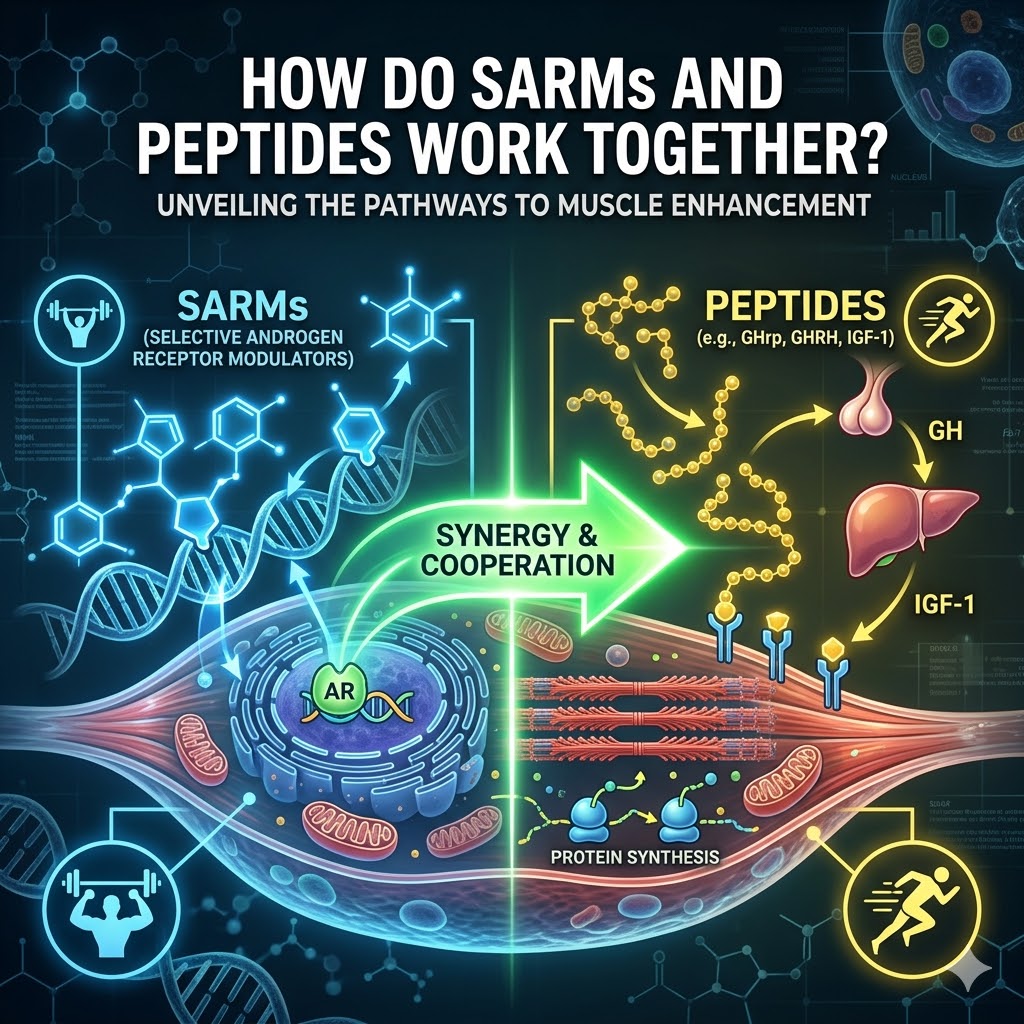
SARMs (such as RAD-140, LGD-4033, and Ostarine) were originally developed to treat muscle-wasting diseases and osteoporosis. Their mechanism of action is found in their name: they are selective.
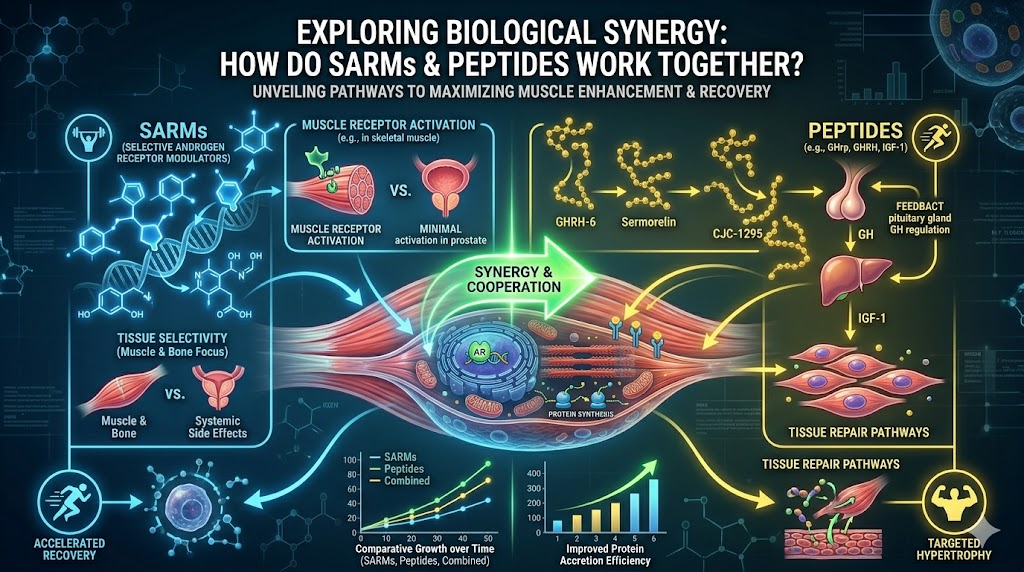
When traditional anabolic steroids enter the bloodstream, they bind to androgen receptors indiscriminately—in muscle tissue, bone, the prostate, the scalp, and the skin. This causes muscle growth, but also prostate enlargement, hair loss, and severe acne. SARMs, on the other hand, are engineered with a unique chemical structure that causes them to bind selectively. They have a high affinity for the androgen receptors located strictly in skeletal muscle and bone tissue, while remaining virtually inactive in the prostate and scalp.
Once a SARM binds to the androgen receptor in a muscle cell, it acts as a transcription factor, instructing the cell’s DNA to drastically upregulate protein synthesis and nitrogen retention. The result is pure, dry muscle hypertrophy (the enlargement of existing muscle cells) and increased bone mineral density.
The Mechanism of Peptides: Cellular Signaling
Peptides operate on a completely different biological axis. A peptide is simply a short chain of amino acids linked by peptide bonds. Because they are structurally small, they do not function as raw building materials. Instead, they act as highly specific chemical messengers.
When a peptide is introduced to the body, it travels through the bloodstream until it finds its specific receptor—acting like a precise key fitting into a specific lock. Once it binds, it signals the body to initiate a natural process.
- Growth Hormone Secretagogues (like CJC-1295 and Ipamorelin): Bind to receptors in the pituitary gland, signaling it to release a massive, natural pulse of the body’s own Human Growth Hormone (HGH).
- Healing Peptides (like BPC-157 and TB-500): Bind to receptors in injured tissue, signaling the body to upregulate actin and initiate angiogenesis (the creation of new blood vessels) to accelerate the healing of tendons, ligaments, and gut tissue.
Part 2: The Biological Synergy of the Stack
The reason SARMs and peptides work so incredibly well together comes down to one fundamental principle in endocrinology: Zero Receptor Competition.
If you take two different SARMs simultaneously, they are both fighting to bind to the exact same androgen receptors in your muscle cells. Eventually, the receptors become saturated, and any excess compound floating in your bloodstream simply causes side effects without adding further anabolic benefit.
Because SARMs and peptides target completely different receptors, there is no competition. They work in parallel, creating synergistic benefits across three distinct biological fronts:
Synergy 1: Hypertrophy meets Hyperplasia (The Ultimate Growth Environment)
As mentioned earlier, SARMs trigger hypertrophy—they command your existing muscle cells to grow larger and store more glycogen. However, you are genetically limited by the total number of muscle cells you possess.
When you introduce a Growth Hormone-releasing peptide (like CJC-1295/Ipamorelin) alongside a SARM, the biological rules change. The peptide stimulates the pituitary to release HGH, which then travels to the liver and converts into IGF-1 (Insulin-like Growth Factor 1). High levels of IGF-1 trigger hyperplasia—the physical splitting and creation of brand new muscle cells.
The Result: The peptides create brand new, empty muscle cells, and the SARM immediately acts upon those new cells to hypertrophy (enlarge) them. This combination allows individuals to push past genetic plateaus that would be impossible to breach with SARMs alone.
Synergy 2: Reinforcing the Chassis (Injury Prevention)
One of the most common issues athletes face when running a potent SARM like RAD-140 is that their muscular strength increases far more rapidly than their connective tissue can adapt. You might add 40 pounds to your bench press in a matter of weeks, but your tendons and ligaments—which have poor blood supply and adapt very slowly—are suddenly subjected to massive, unfamiliar torque. This is a recipe for severe tendonitis or catastrophic tears.
This is where the synergy of healing peptides becomes vital. By combining a SARM with BPC-157 and TB-500, you are aggressively reinforcing the structural chassis of your body while you build the engine.
- The SARM aggressively strengthens the skeletal muscle and increases bone mineral density.
- BPC-157 forces new blood vessels to grow directly into the avascular tendons and ligaments, delivering the oxygen and nutrients needed to strengthen them alongside the muscle.
- TB-500 regulates cellular mobility, preventing the formation of rigid scar tissue and keeping the muscle fascia flexible as it grows.
Together, they allow for rapid increases in strength while practically bulletproofing the joints against injury.
Synergy 3: Amplified Recomposition (Simultaneous Fat Loss and Muscle Gain)
Achieving a true “recomp”—building muscle while simultaneously burning fat—is notoriously difficult, as the two goals require opposing caloric environments. The SARM + Peptide synergy creates a metabolic loophole.
SARMs are highly anti-catabolic. If you place your body in a caloric deficit, a SARM (like Ostarine/MK-2866) will forcefully instruct the body to hold onto its lean muscle tissue, preventing muscle wasting.
Simultaneously, peptides like Ipamorelin or HGH Fragment 176-191 aggressively bind to fat cells and trigger extreme lipolysis (the breakdown of fat lipids for energy). The growth hormone pulses forced by the peptides shift the body’s metabolic preference, commanding it to use deep, stubborn visceral fat as its primary fuel source.
The Result: The SARM preserves and hardens the muscle tissue in a caloric deficit, while the peptide actively accelerates the oxidization of adipose tissue.
Part 3: The Role of Peptides in Post Cycle Therapy (PCT)
Perhaps the most strategic way SARMs and peptides work together is during the critical window of Post Cycle Therapy (PCT).
While SARMs are selective, they are still suppressive. When you introduce an exogenous compound that acts upon the androgen receptor, your Hypothalamic-Pituitary-Testicular Axis (HPTA) recognizes the elevated androgenic activity and scales back its own natural production of testosterone. When a SARM cycle ends, the user must undergo PCT (usually using a SERM like Enclomiphene or Nolvadex) to restart their natural testosterone production.
During this 4-to-6-week PCT window, the body is in a highly vulnerable, catabolic state. Testosterone is low, cortisol is high, and the newly built muscle is at risk of wasting away.
Peptides are the ultimate PCT bridge. Because peptides do not interact with the androgen receptor or the HPTA axis, they are 100% non-suppressive to natural testosterone.
By continuing to run Growth Hormone secretagogues (like CJC-1295) and recovery peptides (like BPC-157) during PCT, the user maintains a highly anabolic, nutrient-partitioning environment via the IGF-1 pathway, completely independent of testosterone. This allows the athlete to retain almost all the muscle and strength gained during the SARM cycle while their natural endocrine system safely reboots in the background.
Conclusion: The Future of Optimization
The integration of SARMs and peptides represents a paradigm shift in how we approach human performance. We are no longer relying on single, blunt-force compounds to force the body into submission. Instead, we are orchestrating a complex biological symphony.
By understanding how these compounds work together, researchers and athletes can build highly specific protocols. SARMs lay the foundation by directing protein synthesis and muscle hypertrophy. Peptides act as the biological support network, optimizing sleep, generating new cells via IGF-1, incinerating visceral fat, and ensuring that tendons and ligaments possess the structural integrity necessary to handle new levels of strength.
When utilized with an understanding of their unique mechanisms, If you’re exploring how to combine these compounds into a practical cycle, see our updated guide on the best SARMs stacks in Canada for 2026. The synergy between SARMs and peptides offers a comprehensive, highly targeted approach to physical optimization that minimizes systemic strain while maximizing sustainable, long-term physical evolution — a principle that remains at the core of advanced supplementation research in 2026.