
 Injectable Steroids
 Oral Steroids
 Peptides
 HGH
HGH Sexual Health
 SARMs
SARMs Syringes & More
 Cycle Support
Viagra vs. Cialis

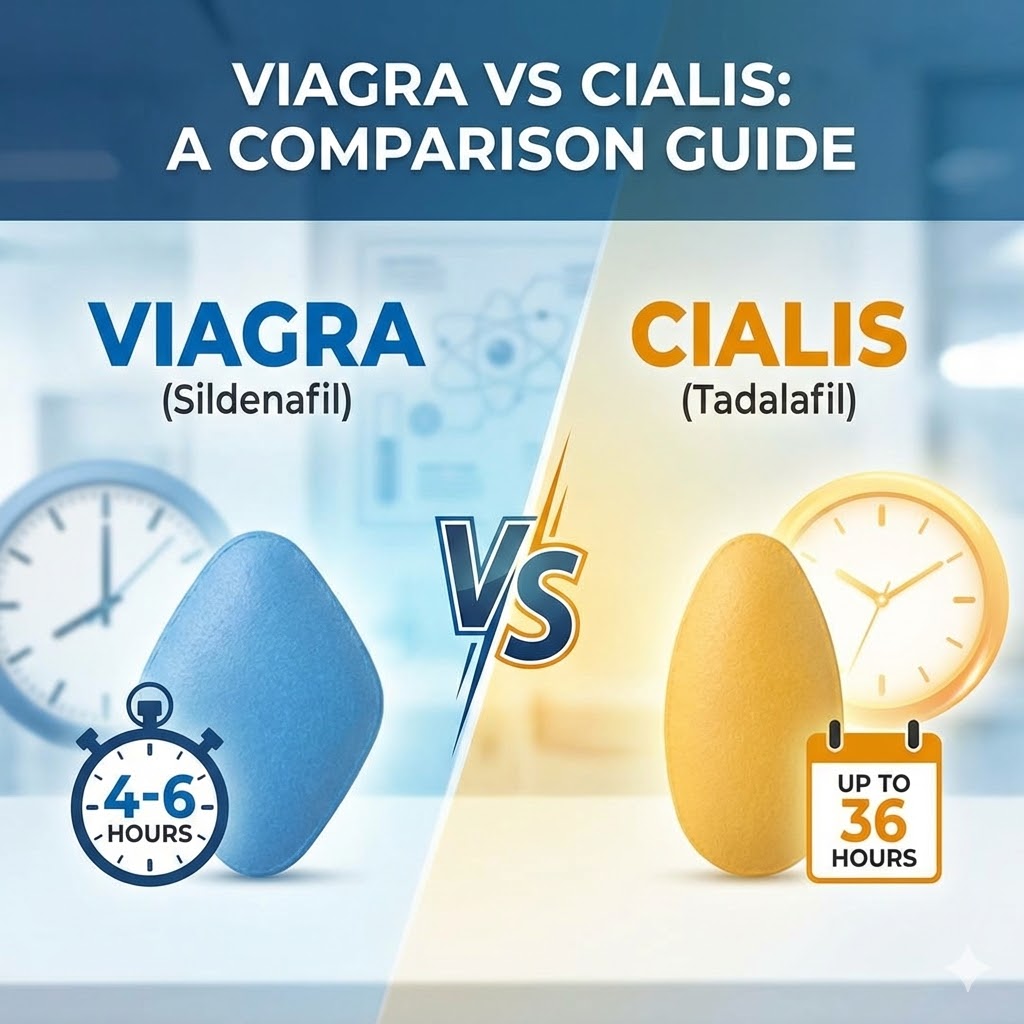
Viagra vs. Cialis: Which ED Medication is Right for You?
Erectile dysfunction (ED) is a common condition affecting millions of men worldwide, yet the solution is often just a prescription away. When it comes to treating ED, two names dominate the conversation: Viagra (Sildenafil) and Cialis (Tadalafil). Both are phosphodiesterase type 5 (PDE5) inhibitors, and both are highly effective at helping men achieve and maintain erections. However, they are not identical.
Choosing between Viagra and Cialis often comes down to lifestyle, timing, and personal preference. Is your priority a medication that works quickly for a specific evening, or do you prefer a daily option that allows for spontaneity? This comprehensive guide breaks down the science, the differences, the side effects, and the best use cases for each to help you decide which option aligns best with your needs.
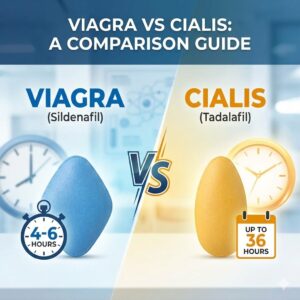
Visualizing the distinct “window of opportunity” provided by Sildenafil (Viagra) versus Tadalafil (Cialis).
Understanding the Mechanism: How They Work
To understand the difference, you first need to understand the similarity. Both Viagra and Cialis work by blocking the PDE5 enzyme. In a healthy erection process, sexual stimulation leads to the release of nitric oxide, which relaxes the smooth muscles in the penis and allows blood to flow in. The PDE5 enzyme eventually breaks down the chemical responsible for this relaxation, ending the erection.
By inhibiting PDE5, these medications ensure that the blood vessels remain relaxed and open for longer periods, allowing for a sustained erection during sexual stimulation. It is important to note that neither medication is an aphrodisiac; they do not cause arousal on their own. Sexual stimulation is still required for them to work.
The Contenders at a Glance
Viagra (Sildenafil)
-
The Original: Approved by the FDA in 1998, Viagra was the first oral treatment for ED and remains the most famous.
-
Best For: Planned sexual activity.
-
Onset: 30 to 60 minutes.
-
Duration: 4 to 6 hours.
-
Food Interaction: Efficacy can be reduced by heavy or fatty meals.
Cialis (Tadalafil)
-
The Weekend Pill: Approved in 2003, Cialis earned its nickname because a single dose can remain active in the body for up to 36 hours.
-
Best For: Spontaneity and weekend-long reliability.
-
Onset: 30 to 45 minutes (sometimes faster).
-
Duration: Up to 36 hours.
-
Food Interaction: largely unaffected by food intake.
Detailed Comparison: Key Differences
While the end result a firm erection—is the same, the user experience differs significantly between the two.
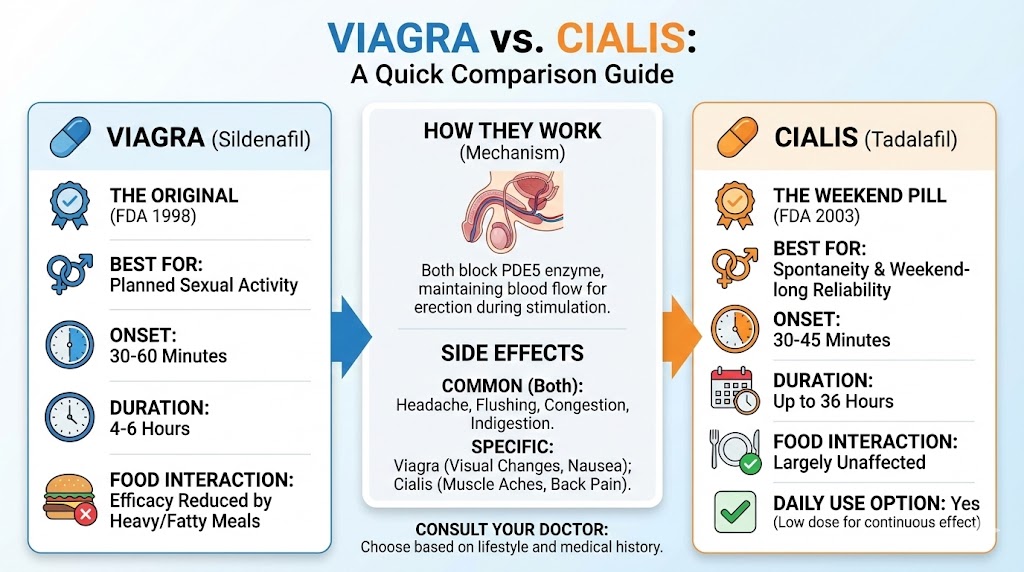
A quick reference guide breaking down the essential differences in timing, duration, and side effects between Viagra and Cialis.
1. Duration of Action (The “Window of Opportunity”)
This is the most distinct difference between the two drugs.
Viagra is a short-acting medication. It is designed to be taken on an “as-needed” basis. Once it kicks in, it remains effective for roughly 4 to 6 hours. This makes it ideal for men who know when they plan to be intimate and want a medication that enters and leaves their system relatively quickly. The short half-life means that if you experience side effects, they will likely dissipate faster than with longer-acting alternatives.
Cialis is the marathon runner of ED medications. With a half-life of 17.5 hours, it remains effective for up to 36 hours. This does not mean you will have an erection for 36 hours; it means you will have the ability to achieve an erection in response to stimulation at any point during that window. This removes the pressure of “watching the clock” and allows for a more natural, spontaneous sexual experience.
2. Dietary Interactions
Diet plays a surprisingly large role in how well these medications work.
Viagra is sensitive to fat. If you take Viagra after a heavy, high-fat meal (like a steak dinner or a burger), absorption will be delayed, and the peak concentration in your blood may be reduced. For the best results, Viagra should be taken on an empty stomach or after a light, low-fat meal.
Cialis offers more flexibility. Its absorption is generally not affected by food type or timing. You can take it with or without food, making it a more convenient option for dinner dates where you don’t want to worry about your menu choices impacting your performance later in the evening.
3. Dosing Protocols: Daily vs. On-Demand
Another major advantage of Cialis is the option for daily use.
-
On-Demand: Both Viagra (25mg, 50mg, 100mg) and Cialis (10mg, 20mg) can be taken as needed, roughly 30-60 minutes before activity.
-
Daily Use: Cialis is unique in that it is FDA-approved for daily use at lower doses (2.5mg or 5mg). By taking a small pill every day at the same time, the medication builds up in your system, ensuring you are “always ready.” This eliminates the need to carry pills or plan intimacy, effectively treating ED as a background condition rather than an event-based one. Viagra does not currently have an approved daily protocol.
Side Effect Profiles
Because they share the same mechanism of action, Viagra and Cialis share many common side effects. However, users often report subtle differences in how these side effects manifest.
Common Side Effects for Both:
-
Headaches
-
Flushing (redness in the face)
-
Nasal congestion
-
Indigestion or upset stomach
Viagra-Specific Side Effects:
-
Visual Changes: Some men taking Viagra report a temporary bluish tinge to their vision or sensitivity to light. This is due to a minor inhibition of PDE6, an enzyme found in the retina.
-
Nausea: Slightly more common with Viagra than Cialis.
Cialis-Specific Side Effects:
-
Muscle Aches and Back Pain: This is the most distinct side effect of Cialis. Some users experience a dull ache in the lower back or thighs roughly 12 to 24 hours after taking the medication. This is usually mild but can be bothersome for some.
The “Priapism” Warning: With both medications, there is a rare risk of priapism—an erection lasting longer than 4 hours. This is a medical emergency that requires immediate attention to prevent permanent tissue damage.
Efficacy: Which One is Stronger?
In clinical trials, both medications have demonstrated high efficacy rates. There is no clear “winner” in terms of strength; 100mg of Viagra is generally considered equipotent to 20mg of Cialis.
However, individual response varies. Some men find that Viagra provides a “harder” erection but with more side effects, while others find Cialis provides a smoother experience. Because body chemistry differs, doctors often recommend trying one; if it doesn’t yield the desired results or the side effects are too harsh, switching to the other often solves the problem.
Cost and Availability
Since the patent expiration of Viagra (in 2017) and Cialis (in 2018), the market has been flooded with generic versions (Sildenafil and Tadalafil). This has drastically lowered the cost of treatment.
-
Brand Name: Pfizer’s Viagra and Lilly’s Cialis remain expensive, often costing $50-$70 per pill without insurance.
-
Generics: Sildenafil and Tadalafil are widely available for a fraction of the price (often under $1-$5 per dose online), making both options highly affordable for most men.
Which Should You Choose?
Choose Viagra (Sildenafil) If:
-
You rarely have sex: If you only engage in sexual activity once or twice a week, an as-needed medication like Viagra may be more logical than a daily pill.
-
You want the drug out of your system quickly: If you dislike the idea of medication staying in your body for days, Viagra’s short half-life is preferable.
-
You are cost-conscious: While both have generics, Sildenafil is sometimes slightly cheaper and more widely manufactured in various dosages.
Choose Cialis (Tadalafil) If:
-
You value spontaneity: If you dislike stopping the moment to take a pill and wait 45 minutes, Cialis (especially the daily version) offers the most natural experience.
-
You want “weekend” coverage: Taking one pill on Friday evening and being covered until Sunday morning is a major convenience for many couples.
-
You have BPH: Cialis is also FDA-approved to treat Benign Prostatic Hyperplasia (enlarged prostate). If you suffer from urinary symptoms associated with BPH, daily Cialis can treat both conditions simultaneously.
Conclusion
Ultimately, the battle of Viagra vs. Cialis isn’t about which drug is “better,” but which drug fits your life. Viagra is the reliable, short-term powerhouse perfect for planned dates. Cialis is the versatile, long-acting option that restores spontaneity.
Many men find that testing both (at separate times) is the best way to determine which one aligns with their body chemistry and lifestyle. Regardless of your choice, consult with a healthcare provider to ensure safety, particularly if you have heart conditions or take nitrates, as combining these with ED medications can be fatal.


One thought on “Viagra vs. Cialis”