

What Does The Wolverine Stack Do
In the realm of high-performance athletics and regenerative medicine, injuries are the ultimate adversary. For decades, the standard prescription for a torn rotator cuff, a strained hamstring, or severe tendonitis was simple: rest, ice, and wait. Recovery was a passive process, often measuring in months or years.
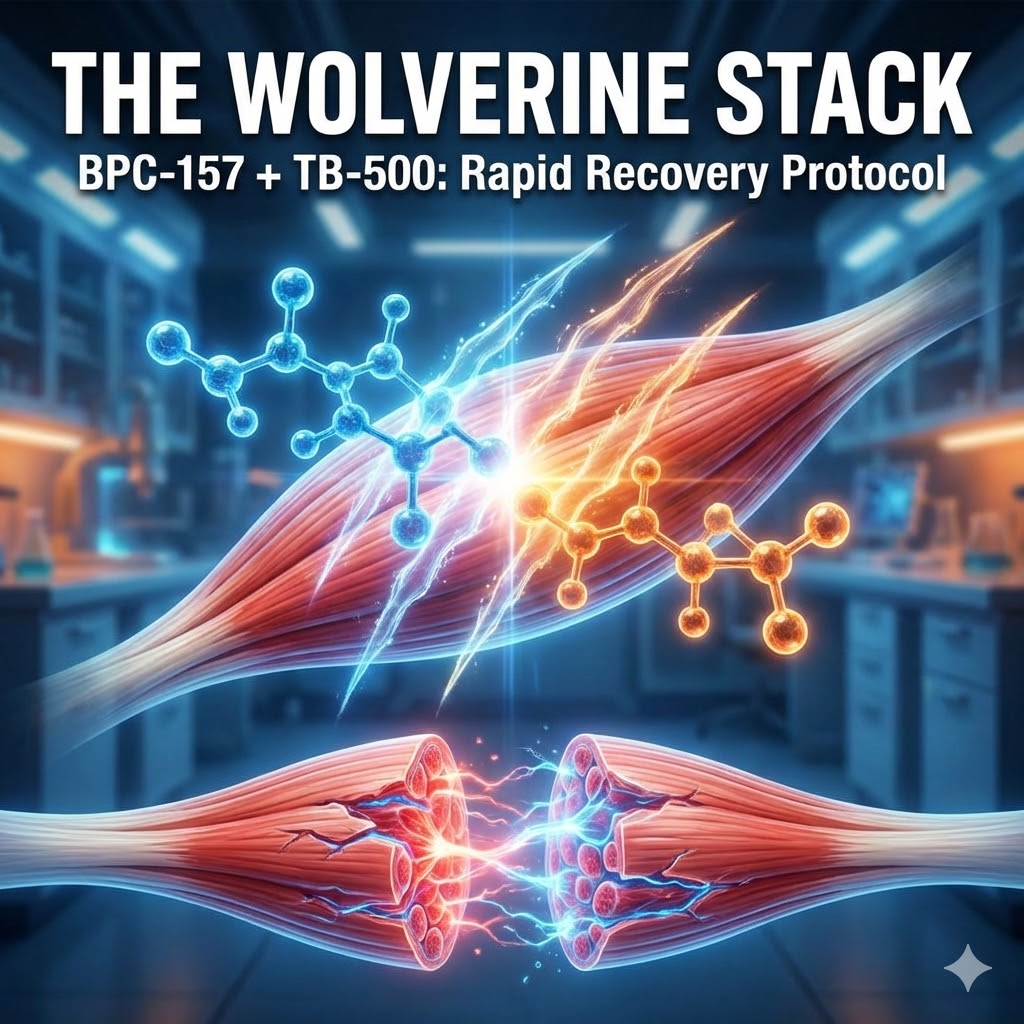
Visualizing the combined reparative power of BPC-157 and TB-500 on damaged muscle tissue.
However, in the last decade, a new protocol has emerged from the underground world of bodybuilding and biohacking, eventually making its way into elite sports therapy. It is called the “Wolverine Stack.”
Named after the Marvel superhero known for his mutant ability to heal from virtually any wound instantly, this protocol combines two powerful peptides—BPC-157 and TB-500—to supercharge the body’s natural repair mechanisms. While it won’t regrow a severed limb or heal a bullet wound in seconds, anecdotal reports and emerging animal research suggest it can dramatically accelerate soft tissue repair, reduce inflammation, and get athletes back in the game in record time.
This guide explores the science, synergy, benefits, and risks of the Wolverine Stack to answer the fundamental question: What does it actually do?
The Components
To understand why the stack is effective, we must first understand the individual players. While both are “healing peptides,” they operate through completely different physiological mechanisms.
1. BPC-157: The Foreman
BPC-157 (Body Protection Compound-157) is a synthetic peptide chain consisting of 15 amino acids. It is derived from a protective protein found naturally in human gastric juice.
In the body, the stomach lining is under constant assault from acid, yet it heals incredibly fast. Scientists isolated the specific protein responsible for this resilience and synthesized BPC-157. While it originated as a gut-healing agent, researchers quickly realized its effects were systemic.
The Mechanism: Angiogenesis The primary limitation of healing in tendons and ligaments is blood flow. Unlike muscles, which are vascular and red, tendons are white and avascular. Nutrients cannot get to the injury site effectively. BPC-157 acts as a potent signaling molecule for angiogenesis—the formation of new blood vessels. It stimulates the expression of the VEGF (Vascular Endothelial Growth Factor) pathway, essentially instructing the body to grow new capillaries into the damaged tissue.
Think of BPC-157 as the Site Foreman. It surveys the damage and orders the construction of new roads (blood vessels) so that supplies can reach the disaster zone.
2. TB-500: The Labor Force
TB-500 is a synthetic fraction of the naturally occurring protein Thymosin Beta-4. This protein is present in almost all human and animal cells but is found in highest concentrations in tissue that heals quickly (like the heart) and platelets.
The Mechanism: Actin Upregulation & Cell Motility While BPC-157 focuses on blood flow, TB-500 focuses on the cells themselves. Its primary function is to regulate actin, a protein that forms the cytoskeleton (the structural framework) of cells.
When tissue is damaged, healthy cells need to migrate from surrounding areas to fill the gap and repair the structure. TB-500 upregulates “cell motility”—it makes cells more mobile. It prevents actin from polymerizing (getting stiff), allowing cells to move fluidly and quickly to the site of injury.
Think of TB-500 as the Labor Force. Once BPC-157 has built the roads, TB-500 mobilizes the workers (cells) and drives them rapidly to the site to begin reconstruction.
The Synergy (Why Stack Them?)
The “Wolverine Stack” is not just about taking two supplements; it is about leveraging biological synergy.
If you use BPC-157 alone, you increase blood flow to the injury, which is helpful. If you use TB-500 alone, you increase the ability of cells to move to the injury, which is also helpful.
But when combined, you create a complete repair ecosystem:
-
Stage 1 (Access): BPC-157 creates the vascular pathways required to transport nutrients and waste products.
-
Stage 2 (Action): TB-500 utilizes those pathways to flood the area with reparative cells and anti-inflammatory agents.
-
Stage 3 (Structure): Both peptides have been shown to influence collagen deposition, ensuring that the healed tissue is organized and strong, rather than a messy lump of scar tissue.
This 1+1=3 effect is why the stack is the gold standard for aggressive injury rehab. Users often report that the combination works significantly faster than either compound in isolation.
Primary Benefits & Applications
The Wolverine Stack is used for a wide variety of physical ailments, but it shines brightest in specific scenarios.
1. Soft Tissue Injuries (Tendons & Ligaments)
This is the “killer app” for the stack. Tendons (connecting muscle to bone) and ligaments (connecting bone to bone) are notoriously slow to heal.
-
Common Uses: Rotator cuff tears, Achilles tendonitis, tennis elbow (lateral epicondylitis), and ACL strains.
-
The Effect: Users often report a significant reduction in pain within 1–2 weeks, with structural improvements allowing for light loading shortly after.
2. Muscle Tears and Strains
While muscles heal faster than tendons, severe tears (Grade 2 or 3) can leave behind scar tissue that limits future performance.
-
The Effect: TB-500 is particularly effective here due to its role in muscle cell differentiation. The stack helps muscle fibers regenerate with proper alignment, reducing the risk of re-injury.
3. Post-Surgical Recovery
Surgeries involve purposeful trauma to tissue. The Wolverine Stack is frequently used off-label by athletes post-surgery to accelerate incision healing and internal repair
-
Note: Many users discontinue the stack 1–2 weeks before surgery to avoid complications with anesthesia or excessive blood vessel growth during the procedure, resuming it immediately post-op.
4. Systemic Inflammation & Flexibility
TB-500 is known to be systemic (traveling through the whole body), while BPC-157 is often debated as being local vs. systemic. Together, they lower systemic inflammatory markers (like C-Reactive Protein).
-
Bonus: Many users report improved flexibility and reduced “stiffness” in uninjured joints while on TB-500, likely due to its effects on actin and tissue elasticity.
Typical Protocols and Usage
Disclaimer: The following information is based on anecdotal reports and common research protocols. These substances are typically classified as research chemicals and are not FDA-approved for human consumption. Always consult a medical professional.
The administration of the Wolverine Stack usually involves subcutaneous injections.
Dosage Ratios
There is no medical standard, but the “bro-science” community has settled on effective ranges:
-
BPC-157: The short half-life (approx. 4 hours) means it is best dosed frequently.
-
Standard: 250mcg to 500mcg, taken twice daily (Total: 500mcg–1mg per day).
-
Location: Ideally injected subcutaneously as close to the injury as possible (e.g., pinched skin over the shoulder for a rotator cuff), though belly fat injection is also effective.
-
-
TB-500: The longer half-life (approx. 7–10 days) allows for less frequent dosing.
-
Loading Phase: 2mg to 5mg per week for the first 4 weeks (often split into two injections, e.g., Monday and Thursday).
-
Maintenance Phase: 1mg to 2mg per month thereafter.
-
Location: Subcutaneously in the stomach (belly fat). It is systemic, so site injection is unnecessary.
-
Cycle Length
-
Acute Injuries: A typical cycle lasts 4 to 6 weeks.
-
Chronic Issues: Some users run lower maintenance doses for 3 months, though cycling off is recommended to prevent the body from building antibodies to the peptides (specifically a concern with TB-500).
The “Dark Side” – Risks and Considerations
No biological free lunch exists. While the Wolverine Stack is celebrated for its safety profile compared to steroids or opioids, it is not without risks.
1. The Cancer Theoretical Risk
This is the most significant concern.
-
The Mechanism: BPC-157 promotes angiogenesis (blood vessel growth).
-
The Risk: Cancer tumors rely on angiogenesis to grow. If they cannot grow blood vessels, they starve.
-
The Verdict: BPC-157 does not cause cancer (it is not carcinogenic). However, if you have existing, active cancer, taking a compound that accelerates blood vessel growth could theoretically fuel the tumor. Anyone with a history of cancer or active malignancy should strictly avoid this stack.
2. Antibody Buildup
TB-500 is a large peptide. If used for extended periods without breaks, the body may recognize it as a foreign invader and develop antibodies against it. This effectively neutralizes the peptide, making it useless, and could theoretically cause cross-reactivity with your natural Thymosin Beta-4.
-
Mitigation: Limit TB-500 use to 6–8 week bursts, followed by a break.
3. Quality Control
These compounds are sold as “research chemicals,” meaning the market is unregulated. Purity varies wildly. Injecting impure peptides can lead to injection site infections, allergic reactions, or exposure to heavy metals.
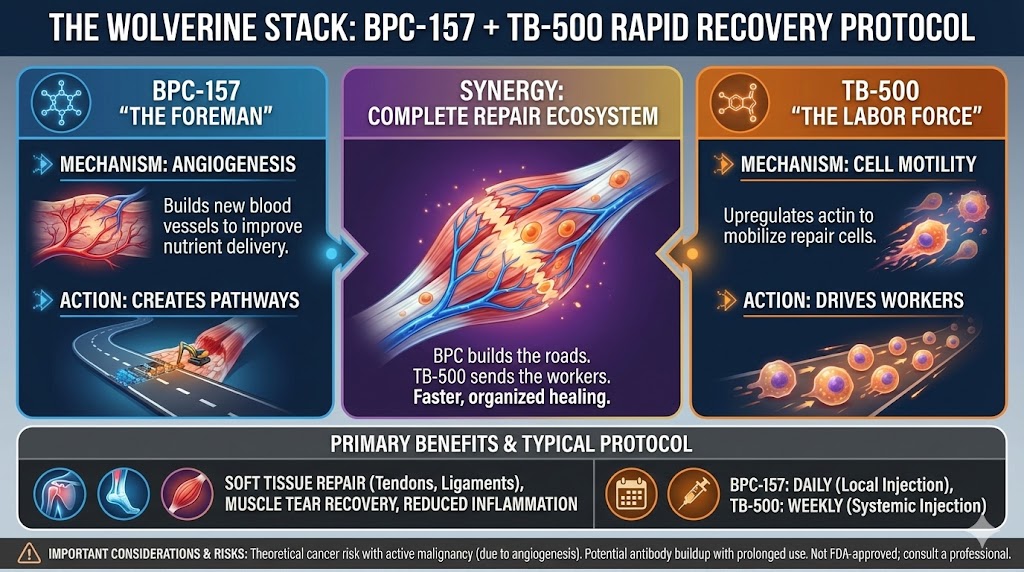
A breakdown of the biological synergy between BPC-157’s angiogenesis and TB-500’s cell motility.
4. Common Minor Side Effects
-
Nausea or gastric distress (usually subsides after a few days).
-
Headaches / Head rush (common with TB-500 injections).
-
Injection site redness or itching.
-
Fatigue (the body uses energy to heal; feeling tired is often a sign the repair process is active).
Conclusion
The Wolverine Stack represents a paradigm shift in how we view recovery. Instead of masking pain with NSAIDs or opioids, BPC-157 and TB-500 attempt to solve the root biological constraints of healing: blood flow and cell migration.
For the athlete staring down a 6-month rehab for a torn pec, or the tradesman with a debilitating rotator cuff, this stack offers a tool that feels almost like magic. It bridges the gap between the body’s natural limitations and the demands of modern performance.
However, it is a tool that requires respect. It is not a daily vitamin to be taken year-round. It is a potent, targeted intervention for specific injuries. When used intelligently, responsibly, and with high-purity sources, the Wolverine Stack is arguably the most effective biohack for physical recovery in existence today.
As research continues, we may one day see these peptides move from the gray market of bodybuilding to the prescription pads of orthopedic surgeons. Until then, they remain the secret weapon of those willing to navigate the frontier of human optimization.
