
 Injectable Steroids
 Oral Steroids
 Peptides
 HGH
HGH Sexual Health
 SARMs
SARMs Syringes & More
 Cycle Support
BPC-157 vs. CJC-1295

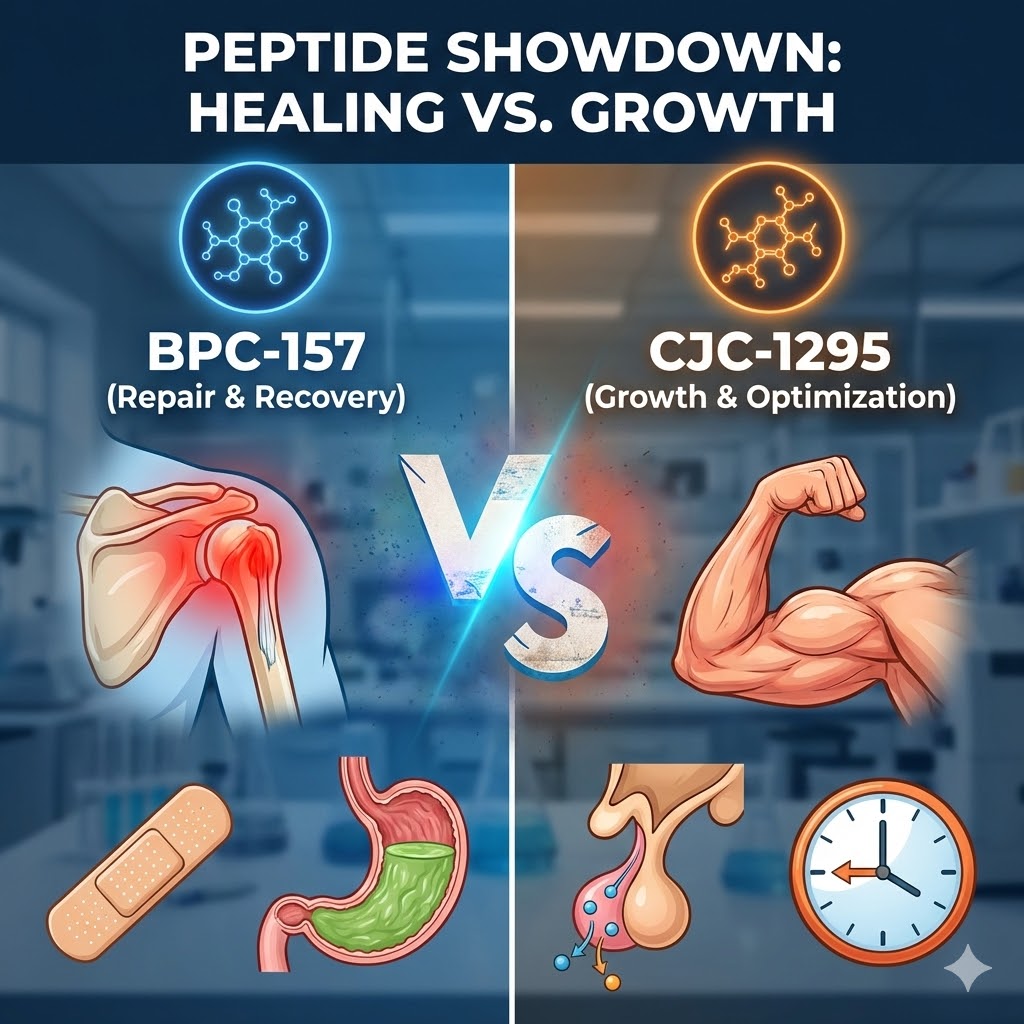
BPC-157 vs. CJC-1295: A Comprehensive Comparison Guide
In the rapidly evolving world of performance enhancement and regenerative medicine, peptides have moved from the fringe of bodybuilding into the mainstream of wellness and anti-aging. Unlike traditional anabolic steroids, which flood the body with exogenous hormones, peptides function as signaling molecules—they whisper instructions to your cells to perform specific functions, such as releasing growth hormone or repairing damaged tissue.
BPC-157 focuses on repairing localized damage, while CJC-1295 amplifies systemic growth and optimization.
Among the hundreds of available peptides, two names consistently rise to the top of the conversation: BPC-157 and CJC-1295.
If you are researching these compounds, you are likely looking for one of two things: accelerated recovery from an injury or overall physical optimization (muscle growth, fat loss, and anti-aging). While they are often discussed in the same breath—and frequently stacked together—they are fundamentally different tools for different jobs.
This guide breaks down the mechanisms, benefits, side effects, and best use cases for BPC-157 and CJC-1295 to help you decide which protocol aligns with your physiological goals.
Part 1: The Wolverine Peptide (BPC-157)
BPC-157 (Body Protection Compound-157) is often referred to as the “healing peptide.” It is a synthetic sequence of 15 amino acids derived from a protective protein found naturally in human gastric juice. Its discovery stemmed from researchers questioning why stomach lining heals so quickly despite being in a highly acidic environment
How It Works: The Mechanic
BPC-157 operates primarily through angiogenesis, the formation of new blood vessels. When tissue is damaged—whether it’s a torn rotator cuff, a strained hamstring, or an ulcerated stomach—healing is often limited by blood flow. Tendons and ligaments, in particular, have notoriously poor blood supply, which is why they take months to heal
BPC-157 accelerates this process by signaling the body to grow new capillaries at the site of injury. It also upregulates the production of collagen and modulates the body’s inflammatory response, moving the tissue from a chronic inflammatory state into a repair state.
Primary Benefits of BPC-157
-
Soft Tissue Repair: It is the gold standard for healing tendons, ligaments, and muscles. It is widely used by athletes to treat tennis elbow, Achilles tendonitis, and ACL injuries.
-
Gut Health: Because it is derived from gastric juices, BPC-157 is exceptionally potent at healing the digestive tract. It is used to treat Leaky Gut Syndrome, IBS, and gastric ulcers.
-
Neuroprotection: Emerging research suggests BPC-157 may help repair nerve damage and protect the brain from neurotoxicity.
-
Systemic vs. Local: While it has systemic effects, many users prefer injecting it close to the site of injury (e.g., near the shoulder for rotator cuff pain) to maximize the localized angiogenic effect.
Part 2: The Growth Architect (CJC-1295)
CJC-1295 belongs to a completely different class of peptides known as Growth Hormone Secretagogues (GHS). Specifically, it is a synthetic analogue of Growth Hormone-Releasing Hormone (GHRH).
How It Works: The Signal Amplifier
Unlike injecting synthetic Human Growth Hormone (HGH)—which shuts down your natural production—CJC-1295 works by stimulating your pituitary gland to produce more of your own growth hormone.
It does this by binding to GHRH receptors in the pituitary. The result is a downstream increase in plasma HGH and, subsequently, IGF-1 (Insulin-like Growth Factor 1). IGF-1 is the primary driver of anabolic growth, cell recovery, and metabolic efficiency in the body.
DAC vs. No DAC
When researching CJC-1295, you will encounter a critical distinction:
-
CJC-1295 with DAC (Drug Affinity Complex): This version has a very long half-life (about a week). It provides a continuous, low-grade bleed of growth hormone.
-
CJC-1295 No DAC (Mod GRF 1-29): This version has a short half-life (about 30 minutes). It creates a natural “pulse” of growth hormone that mimics the body’s circadian rhythm. Most experts and users prefer “No DAC” because continuous GH bleeding can desensitize the pituitary gland and lead to water retention (“water bloat”).
Primary Benefits of CJC-1295
-
Muscle Hypertrophy: Increased IGF-1 levels support the development of lean muscle tissue.
-
Fat Loss: Elevated growth hormone levels increase lipolysis (fat burning), making it easier to lean out.
-
Anti-Aging & Sleep: Users often report deeper REM sleep, improved skin elasticity (collagen production), and higher energy levels.
-
Recovery: while BPC fixes specific injuries, CJC improves the body’s overall ability to recover from training stress.
Part 3: Head-to-Head Comparison
To choose between them, you must identify your primary constraint: Are you injured, or are you optimizing?
1. The Goal
-
BPC-157 is for Repair. Think of it as a specialized construction crew you hire to fix a hole in the roof. If you have a specific injury, surgery recovery, or chronic nagging pain, BPC-157 is the superior choice.
-
CJC-1295 is for Optimization. Think of it as upgrading the foundation of the house. If your goal is to build muscle, lose body fat, sleep better, and improve general recovery from the gym, CJC-1295 is the tool.
2. The Timeline of Results
-
BPC-157: Results are often felt quickly regarding pain relief. Anti-inflammatory effects can be noticed within days, while structural tissue repair (like a tendon) typically takes 4–6 weeks of consistent use.
-
CJC-1295: This is a slow burn. Because it relies on raising IGF-1 levels, physical changes (muscle gain, fat loss) take time. Sleep improvements usually happen in the first week, but cosmetic changes often require 3–6 months of protocol.
3. Administration & Dosing
-
BPC-157: Typically administered 1–2 times daily. It is often injected subcutaneously near the injury site, though systemic use (belly fat) works for gut health. Oral versions are also available specifically for gut issues.
-
CJC-1295: Typically administered 1–3 times daily, ideally on an empty stomach (food blunts the GH pulse). It is almost always injected subcutaneously in the abdomen. It is frequently combined with Ipamorelin (another peptide) to maximize the growth hormone pulse without increasing cortisol.
Part 4: Side Effects and Safety Profile
Both peptides are generally considered safer than anabolic steroids because they do not suppress testosterone production or cause severe androgenic side effects (hair loss, acne, rage). However, they are not risk-free.
BPC-157 Side Effects: BPC-157 is famous for its lack of side effects. Most users report zero negative reactions.
-
Rare: Mild nausea or headache initially.
-
Theoretical Risk: Because it promotes angiogenesis (blood vessel growth), there is a theoretical concern that it could feed active tumors/cancer, as tumors need blood supply to grow. Those with active cancer should strictly avoid it.
CJC-1295 Side Effects: Because it manipulates hormones, CJC-1295 carries more noticeable physical side effects.
-
Head Rush: Many users experience a warm “flush” or head rush immediately after injection. This is normal and indicates the peptide is hitting the receptors.
-
Water Retention: Increased GH levels can cause water retention in the hands and feet. This is more common with the “DAC” version or if the dose is too high.
-
Insulin Sensitivity: Chronic elevation of GH can slightly increase blood glucose. It is recommended to monitor blood sugar if using it long-term.
-
Cortisol: If not paired with Ipamorelin (which is selective), CJC-1295 can sometimes slightly elevate cortisol (stress hormone) and prolactin, though this is rare at standard doses.
Part 5: The Synergy (Why Not Both?)
The reason this “Versus” comparison is difficult is that the answer for many athletes is “Both.”
BPC-157 and CJC-1295 are arguably the most popular peptide stack in existence because they cover the entire spectrum of recovery:
-
CJC-1295 creates a high-resource environment. It floods the blood with IGF-1 and Growth Hormone, ensuring the body has the materials and signals needed to grow and repair.
-
BPC-157 directs the traffic. It ensures that the repair mechanisms are targeted efficiently at damaged connective tissue and reduces the inflammation that prevents healing.
The “Wolverine” Stack: If an athlete tears a pec muscle, a common protocol involves:
-
BPC-157 locally at the injury site to knit the tissue back together.
-
CJC-1295 (+ Ipamorelin) systemically to improve sleep and drive anabolic processes globally.
This combination is believed to reduce recovery times significantly compared to natural healing alone.
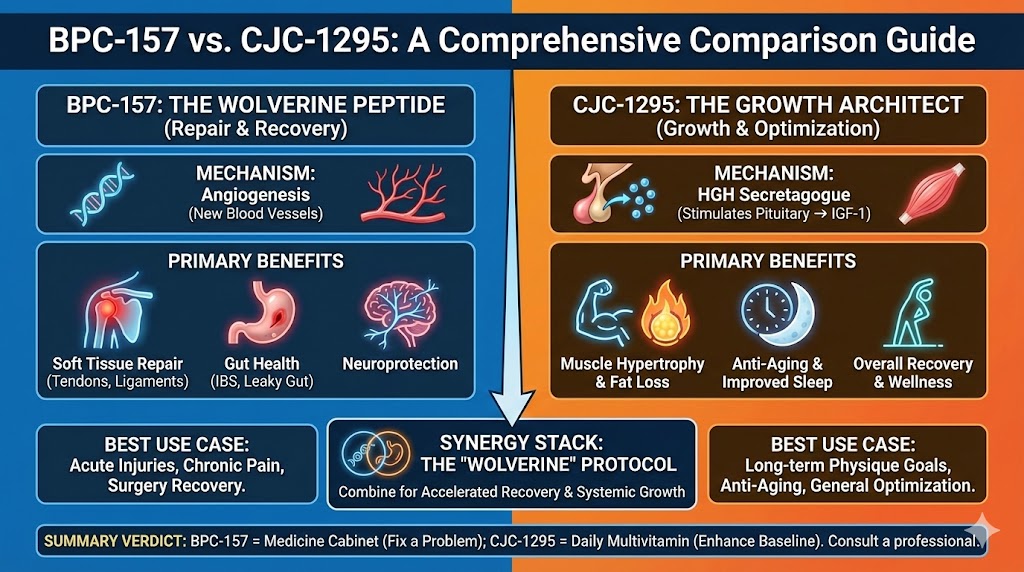
A visual breakdown of the distinct mechanisms, benefits, and use cases for the “Healing” peptide vs. the “Growth” peptide.
Conclusion: Which is Right for You?
The decision ultimately comes down to your current physical state.
Choose BPC-157 If:
-
You have a specific acute injury (tear, strain, sprain).
-
You suffer from chronic tendonitis (tennis elbow, jumper’s knee).
-
You have digestive issues (IBS, leaky gut, ulcers).
-
You want a compound with virtually no side effects that focuses purely on repair.
Choose CJC-1295 If:
-
You are healthy and want to take your physique to the next level.
-
You want to accelerate fat loss and muscle growth.
-
You are looking for anti-aging benefits (better skin, hair, energy).
-
You struggle with sleep quality.
-
You are willing to commit to a longer protocol (3+ months) to see results.
Summary Verdict: Think of BPC-157 as your medicine cabinet—something you pull out when things go wrong and you need to fix a problem. Think of CJC-1295 as your daily multivitamin on steroids—something you use to enhance your baseline performance and quality of life over the long term.


0 thoughts on “BPC-157 vs. CJC-1295”