Injectable Steroids
 Oral Steroids
 Peptides
 HGH
HGH Sexual Health
 SARMs
SARMs Syringes & More
 Cycle Support
What Does the Wolverine Stack Target?

What Does the Wolverine Stack Target?
In the high-stakes world of performance athletics, bodybuilding, and physical rehabilitation, time is the enemy. A torn rotator cuff, a strained hamstring, or chronic tendonitis can sideline an athlete for months, if not years. The traditional medical approach—Rest, Ice, Compression, Elevation (RICE)—is effective but passive. It relies entirely on the body’s natural, often slow, timeline.
Enter the “Wolverine Stack.”
Named after the Marvel superhero known for his mutant ability to heal instantly from any wound, this peptide protocol has become legendary in biohacking circles. It combines two specific compounds—BPC-157 and TB-500—to target the biological bottlenecks of recovery. But what exactly does it target? It doesn’t just “speed up” healing in a vague sense; it systematically addresses the specific physiological limitations that prevent tissue from repairing itself.
By understanding the distinct biological targets of BPC-157 and TB-500, we can see how they create a “Complete Repair Ecosystem” that bridges the gap between injury and peak performance.
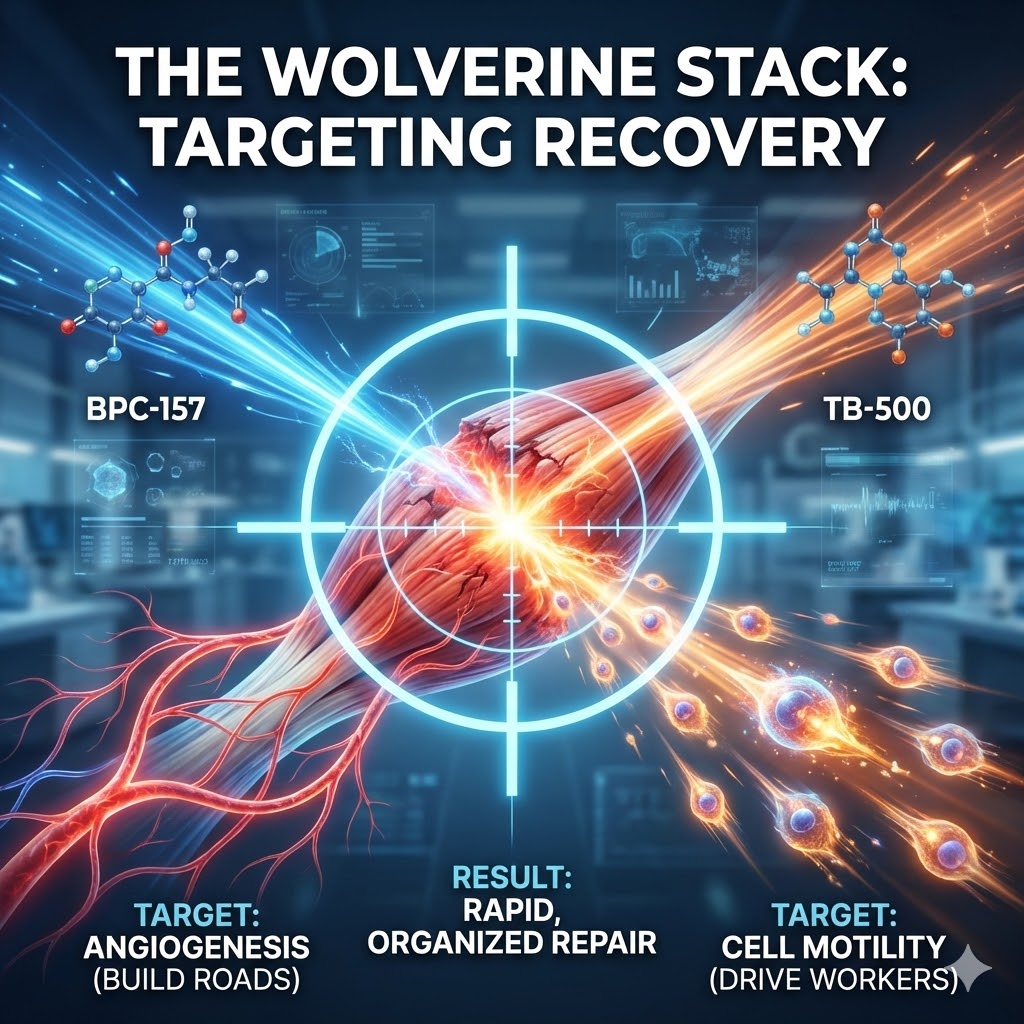
Visualizing the precision strike of the Wolverine Stack: BPC-157 builds the roads while TB-500 drives the workers.
Target 1: The Circulatory Limitation (Angiogenesis)
The first and most critical target of the Wolverine Stack is the body’s circulatory infrastructure. The primary agent for this target is BPC-157, often referred to as “The Foreman” of the repair site.
The Biological Bottleneck: Lack of Blood Flow
To understand why BPC-157 is necessary, you must understand why certain tissues fail to heal. Muscles are highly vascular; they are red and filled with blood, which is why a muscle tear often heals relatively quickly. However, tendons (connecting muscle to bone) and ligaments (connecting bone to bone) are what scientists call “avascular” or “white tissue.” They have very poor blood supply.
Without a robust blood supply, the body cannot transport the raw materials—amino acids, oxygen, and repair cells—needed to fix the damage. This is why a partially torn Achilles tendon can linger for years without fully healing.
The Solution: Angiogenesis
BPC-157 specifically targets this limitation by stimulating a process called angiogenesis—the physiological process through which new blood vessels form from pre-existing vessels.
-
** VEGF Pathway:** BPC-157 upregulates the Vascular Endothelial Growth Factor (VEGF) pathway. This signals the body to sprout new capillaries directly into the site of the injury.
-
The “Road” Metaphor: If the injury site is a construction zone, blood vessels are the roads leading to it. If the roads are blocked or non-existent, the supply trucks can’t get through. BPC-157 builds the roads.
-
Nutrient Delivery: By successfully targeting angiogenesis, BPC-157 ensures that the injury site is flooded with the nutrients required for reconstruction, effectively turning “white,” slow-healing tissue into a more active, vascularized repair zone.
Target 2: Cellular Mobility and Structure (Actin Upregulation)
While BPC-157 handles the infrastructure, the second half of the stack, TB-500, targets the workforce. TB-500 is a synthetic version of Thymosin Beta-4, a naturally occurring protein, and acts as “The Labor Force”.
The Biological Bottleneck: Cellular “Stiffness”
Even if you have perfect blood flow (roads), you still need workers (cells) to physically move to the site of the damage to close the wound. In a natural state, this cellular migration can be slow or inefficient, especially in older adults or severe injuries where inflammation restricts movement.
The Solution: Cell Motility
TB-500 targets cell motility—the ability of a cell to move spontaneously and actively, consuming energy in the process.
-
Actin Upregulation: The primary mechanism of TB-500 is its interaction with actin, a protein that forms the cytoskeleton (the structural skeleton) of the cell.
-
Mobilizing the Repair Crew: By preventing actin from polymerizing (becoming rigid), TB-500 keeps cells flexible and mobile. This allows reparative cells (such as fibroblasts and keratinocytes) to travel rapidly through tissues to reach the site of the injury.
-
Distance Healing: Because TB-500 is systemic (it travels through the whole body regardless of where you inject it), it can “drive workers” to injuries in distant parts of the body, whether it’s a shoulder impingement or a knee strain.
Target 3: Specific Tissue Types (The “Hard-to-Heal” Areas)
When BPC-157 and TB-500 are combined, they target specific tissue types that are notoriously resistant to natural healing. The stack is not typically used for simple bruises or scratches; it is targeted at structural failures.
1. Soft Tissue (Tendons & Ligaments)
This is the “killer app” for the Wolverine Stack. As noted in the infographic, the stack acts as a Soft Tissue Repair specialist.
-
Tendons: Injuries like tennis elbow (lateral epicondylitis), golfer’s elbow, and patellar tendonitis are caused by micro-tears in the tendon that outpace the body’s ability to repair them. The Wolverine Stack targets the collagen organization in these tendons, helping to realign fibers and increase load-bearing capacity.
-
Ligaments: For ACL or MCL sprains, the stack targets the ligament’s structural integrity, potentially reducing the laxity (looseness) that often follows a sprain.
2. Muscle Tissue (Tears and Strains)
Muscle tears (Grade 2 or 3) often heal with significant scar tissue (fibrosis). Scar tissue is weaker and less flexible than healthy muscle, leading to high rates of re-injury.
-
The Target: The Wolverine Stack targets Muscle Tear Recovery by promoting “regeneration” rather than just “repair”.
-
Reduced Fibrosis: By modulating inflammation and ensuring rapid cell migration (TB-500), the stack helps muscle fibers knit back together in alignment, rather than forming a disorganized clump of scar tissue.
3. The Gut Lining (Systemic Health)
While often overlooked by athletes focused on muscles, BPC-157 was originally discovered in gastric juice. It has a profound targeting effect on Gut Health.
-
The Target: It targets the epithelial lining of the digestive tract.
-
The Application: It is widely used to treat Leaky Gut Syndrome, Irritable Bowel Syndrome (IBS), and ulcers. A healthy gut absorbs nutrients better, which indirectly supports systemic recovery and lowers whole-body inflammation.
Target 4: The Inflammatory Response
Inflammation is a double-edged sword. Acute inflammation is necessary to trigger healing, but chronic inflammation halts it. The Wolverine Stack targets the modulation of this response.
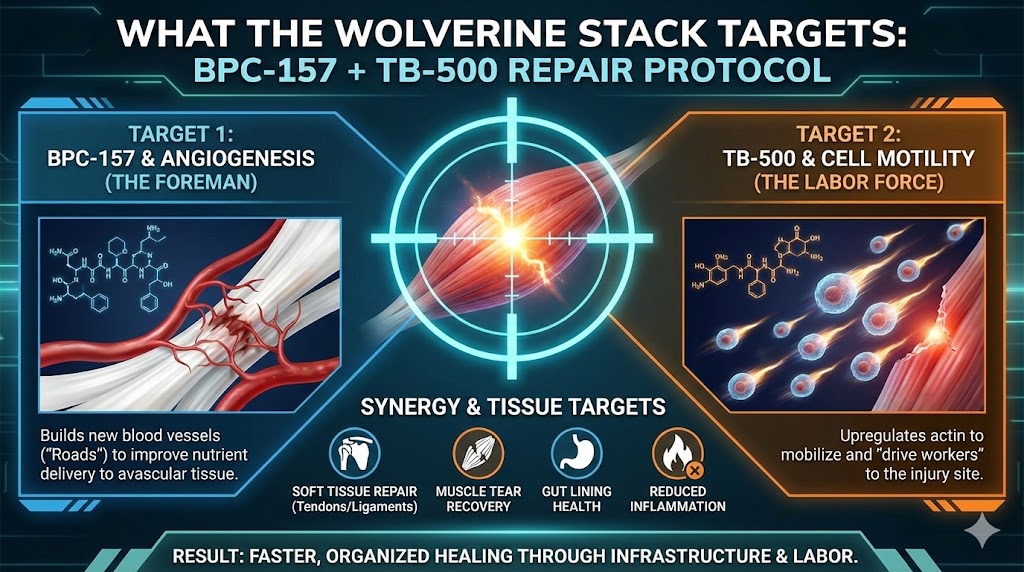
A visual guide to the specific biological targets of the Wolverine Stack: circulatory infrastructure and cellular mobilization.
The Biological Bottleneck: Chronic Inflammation
After an injury, the body rushes inflammatory markers to the site. If this persists too long, the tissue becomes “stuck” in an inflammatory cycle, leading to chronic pain and degeneration (tendinosis).
The Solution: Modulation, Not Suppression
Unlike NSAIDs (like Ibuprofen) which completely block inflammation (and can actually hinder long-term healing), the Wolverine Stack targets Reduced Inflammation by resolving it.
-
BPC-157: Acts to balance the inflammatory markers, moving the tissue from the “react” phase to the “repair” phase.
-
TB-500: Has been shown to reduce systemic inflammation throughout the body, often resulting in users reporting that “old aches and pains” disappear alongside the acute injury they are treating.
The Synergy: Why the Stack Targets Better Than Solos
The true power of the Wolverine Stack lies in its Synergy.
If you were to use BPC-157 alone, you might successfully build new blood vessels (roads) to the injury, but if your repair cells are sluggish or immobile, the healing will still be slow. Conversely, if you use TB-500 alone, you might mobilize millions of repair cells (workers), but if there is no blood flow (roads) to get them to the site, they cannot do their job effectively.
By stacking them, you target the entire Repair Ecosystem:
-
BPC-157 builds the roads.
-
TB-500 drives the workers.
-
Together, they ensure faster, organized healing.
Important Considerations and Risks
While the targets of the Wolverine Stack are beneficial for healing, it is crucial to understand the risks associated with these mechanisms, as highlighted in the safety warnings.
1. The Cancer Risk (Angiogenesis)
The same mechanism that makes BPC-157 effective—Angiogenesis—is also a mechanism used by cancer tumors. Tumors need a massive blood supply to grow. If they cannot grow blood vessels, they starve.
-
The Risk: There is a theoretical risk that if you have an active malignancy (cancer), taking a potent angiogenesis stimulator like BPC-157 could accelerate the tumor’s growth. It does not cause cancer, but it could act as “gasoline on the fire” for existing cancer.
2. Antibody Buildup
TB-500 is a large, complex peptide. If used for too long without a break, the body may recognize it as a foreign invader.
-
The Risk: The body may produce antibodies that neutralize the peptide, rendering it useless. Worse, these antibodies could cross-react with your natural Thymosin Beta-4, potentially weakening your natural immune and repair systems.
Conclusion
The Wolverine Stack targets the fundamental biological limits of the human body. It targets the lack of blood flow in tendons, the slow movement of repair cells, and the destructive nature of chronic inflammation.
By understanding these targets, athletes and patients can see why this protocol has moved from the underground to the forefront of regenerative medicine. It is not a general “boost”; it is a precision strike against the physiological barriers that keep us injured.
Whether treating a rotator cuff that won’t heal or a hamstring that keeps popping, the Wolverine Stack offers a targeted solution: Build the roads, send the workers, and fix the damage.